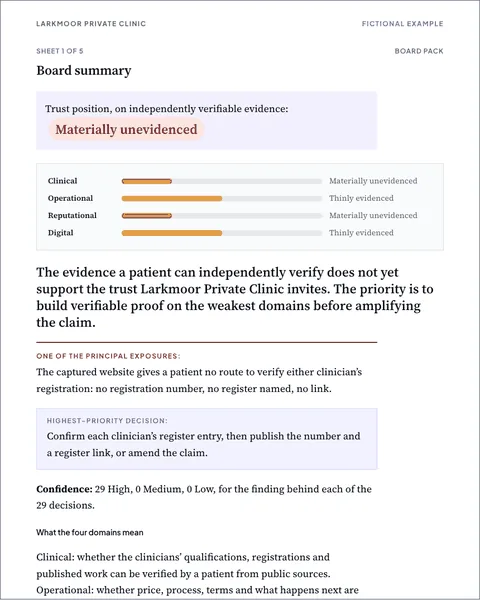
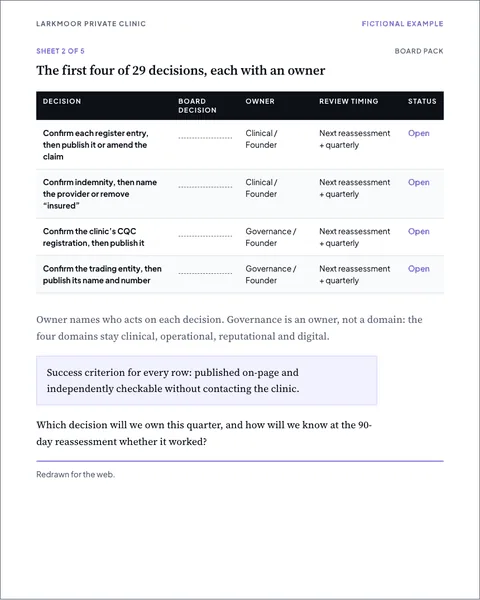
Larkmoor Private ClinicBoard packKey decisions01Confirm each clinician’s register entry02Confirm the indemnity arrangement03Confirm the practice’s own registration
Larkmoor Private ClinicOverall verdictMaterially unevidencedPatients cannot check most of what the site claims.Clinical evidenceOperational transparencyReputational integrityDigital experience
We check what a practice tells patients from the patient’s perspective.
We show you what a patient can and cannot independently verify and what would close each gap.
What it does for your practice
Answer patients’ questions before they book. Show who will treat them, link the registers that confirm it and say where your reviews come from. A patient comparing practices then has fewer reasons to look elsewhere.
Set expectations before treatment. Make prices, risks and aftercare clear before a patient decides, so what they experience matches what they were told.
Fix the proof before you pay to promote it. Your report puts the gaps in priority order, so you can make a claim checkable before you spend money advertising it.
Be ready for patients who ask an AI tool. Some UK adults now say they first turn to an AI tool for health information. Whatever they use, they can only rely on what can be checked.
What the report means for you: it shows what a patient can and cannot check about you today, and what to fix first.
What you tell patients1What a patient can check2What a patient can verify3
1What you tell patients
2What a patient can check
3What a patient can verify
Couldn’t find it is not the same as doesn’t have it. We say which is which.
The overall verdict and the four domain bands beneath it, each on independently verifiable public evidence
Overall verdict
Materially unevidenced
Less evidenceMore evidence
The site’s material claims about who treats patients, how the practice is regulated and what treatment achieves can be read on the site but not checked from it. These findings identify missing public evidence. They do not establish why it is missing.
Clinical evidence
Materially unevidenced
Rests on credentials the clinic states for itself: a named medical director, a stated 2009 qualification, a menopause-care diploma in a blog byline. The pages give no GMC numbers. The checks shown here do not establish whether the named doctors can be matched to the GMC register. No risks are stated on the pages checked.
Operational transparency
Thinly evidenced
Promises a reply within one working day and a stated aftercare route, but gives no telephone number or opening hours, no complaints route and no fees.
Reputational integrity
Materially unevidenced
A 4.9 rating from 340-plus reviews and two patient quotes, but the platform is never named or linked, and both quotes are anonymous and undated.
Digital experience
Thinly evidenced
Eleven pages captured with no errors, consistent navigation and plain copy, but no photograph of the premises, the consulting rooms or any clinician.
Band legend, weakest to strongest
Materially unevidenced
Thinly evidenced
Stronger bands, unlabelled in this example
Redrawn for the web.Report page 4
A strong result means the provider’s public evidence is clear, consistent and checkable. It does not mean its clinical care is good, that its treatments are appropriate, or that it is safe.
Larkmoor Private ClinicPatient Trust Diagnostic
Example page 2 of 3 Report page 15
After reviewing the site, a self-funding patient still cannot answer 15 of the questions we put to it
Each one is an opportunity.
What is the telephone number, and when are you open?
How do I complain, and to whom do I escalate?
What is either doctor’s GMC number, and where do I check it?
What will this cost, and is the consultation itself chargeable?
What happens if the full-body health screen finds something, who follows it up, and what are my alternatives?
What does the ‘results within 48 hours’ promise actually cover, and what happens if it is missed?
Which platform holds the 340 reviews, and how do I read them for myself?
Who reviews my blood results, a doctor or a nurse?
What are Dr Fenwright’s qualifications?
Who is the practice manager I am told to write to about my records, and at what address or email?
What happens to the data I type into the booking form, on what basis, for how long, and who do I complain to about it?
Who is the legal entity behind Larkmoor Private Clinic, and is it registered with the Care Quality Commission?
When was the 98 per cent figure calculated, or last reviewed?
Who do I call if I feel unwell after a treatment at ten o’clock on a Saturday night?
Did my booking request actually send?
Band legend, weakest to strongest
Materially unevidenced
Thinly evidenced
Stronger bands, unlabelled in this example
Redrawn for the web.Report page 15
Larkmoor Private ClinicPatient Trust Diagnostic
Example page 3 of 3 Evidence appendix
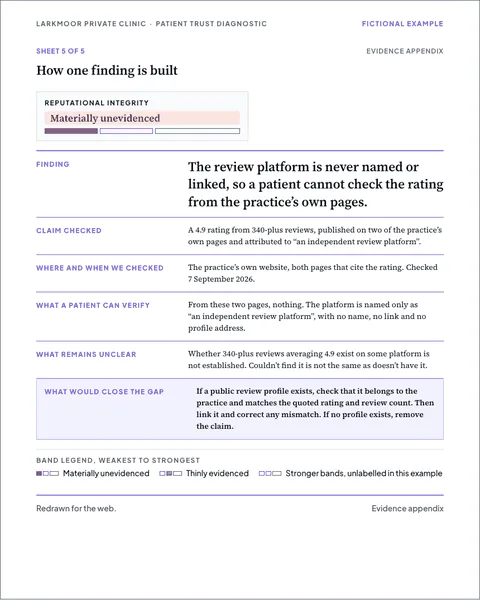
How one finding is built
Reputational integrity
Materially unevidenced
Finding
The review platform is never named or linked, so a patient cannot check the rating from the practice’s own pages.
Claim checked
A 4.9 rating from 340-plus reviews, published on two of the practice’s own pages and attributed to “an independent review platform”.
Where and when we checked
The practice’s own website, both pages that cite the rating. Checked 7 September 2026.
What a patient can verify
From these two pages, nothing. The platform is named only as “an independent review platform”, with no name, no link and no profile address.
What remains unclear
Whether 340-plus reviews averaging 4.9 exist on some platform is not established. Couldn’t find it is not the same as doesn’t have it.
What would close the gap
If a public review profile exists, check that it belongs to the practice and matches the quoted rating and review count. Then link it and correct any mismatch. If no profile exists, remove the claim.
Band legend, weakest to strongest
Materially unevidenced
Thinly evidenced
Stronger bands, unlabelled in this example
Redrawn for the web.Evidence appendix
How it works
We partner with you from the first call until patients can check what you tell them.
1
A short call. We agree the scope and what you want to achieve, and you share a few figures, such as your average new-patient value.
2
We check. Public evidence only, each item recorded with where and when we found it.
3
We present. We take you through the findings and what each one means for your patients.
4
We partner with you. Our Advisory programme turns the findings into a plan and helps your team close the gaps.
5
We repeat. A repeat Diagnostic, on a cycle we agree with you, shows what has changed.
We show our working. Every finding comes with the evidence and the date we checked it.
of UK adults who had used a practitioner have used a verified source, such as a government-backed register, before booking non-surgical aesthetic treatments, therapy or a private ultrasound.
Few use a register before booking, so the proof needs to be on your own pages.
of people seeking Botox, fillers or other non-surgical cosmetic treatments say five-star reviews influence them; 29% rely on before-and-after photos or testimonials on social media.
of UK adults rank approval by an official body, such as a regulator, first among the things that would help them trust information about private healthcare. It was the factor most often chosen.
Official backing was the trust factor chosen most often. Point patients to yours.
On 2 July 2026 the Competition and Markets Authority welcomed PHIN reaching its gold compliance milestone under the Private Healthcare Order. The Order requires private hospitals to publish performance data, and consultants their fees, through PHIN.
On 6 October 2026 the government accepted all 44 recommendations of the National Commission into the Regulation of AI in Healthcare, with new commitments to keep patients informed about when AI is used in their care. These are commitments, not yet law.
AI scribe tools that support diagnosis, treatment or prevention, or take automated action without clinician review, are regulated as medical devices. What a tool is said to do decides how it is regulated.
In an October 2026 ruling against an online pharmacy, the Advertising Standards Authority treated a landing page reached from a paid social media ad like a homepage, and restated that prescription-only medicines must not be advertised to the public.
Since April 2025, fake reviews and paid-for reviews not clearly marked as incentivised have been banned practices under the Digital Markets, Competition and Consumers Act 2024. The ban also covers hiding negative reviews and star ratings that give an inaccurate picture.
“You must make sure the information you publish is factual and can be checked, and does not exploit patients’ vulnerability or lack of medical knowledge.”
Our founding partners are the first providers to receive the Patient Trust Diagnostic. We name them on our website as the providers who chose to go first.
What founding partners receive
Your practice named on our website as a founding partner, with your logo.
Founding terms, set out in writing before we start.
We help private healthcare providers show patients they can be trusted, in ways patients can check for themselves. It started with what we noticed as patients. The people treating us could be checked. Much of what we were told could not. The practices that get this right should earn the trust they deserve.
Dale has spent nearly two decades in risk, compliance and governance at some of the most regulated firms in finance, including HSBC, Schroders and Wellington Management. At HSBC he chaired HSBC Asset Management’s global financial-crime and compliance management committee and sat on two of its internal entity boards. At Wellington he led financial-crime risk globally. He co-founded Titan Partners Group, an M&A and corporate-finance advisory firm, and was its COO. He sits on the HIMSS27 Europe Programme Committee as patient representative, and brings the perspective of a patient living with stage IV cancer.
Louise’s background
Louise has spent more than two decades in enterprise technology, across cybersecurity, software, strategic sales and channel development. Most recently she was Sales Director, Security for Northern Europe at VMware, where she grew a security business from about four people to more than fifty. Earlier, she led the Palo Alto Networks division at Westcon Security and co-founded VW Technology. She also brings the perspective of a patient living with MS.
Speaking and programme roles
HIMSS Europe 2026, CopenhagenDale, invited speaker and panellist